
Have you ever had butterflies before a big moment, or felt a knot in your stomach when worry set in? Those feelings aren't just in our heads. They're a conversation between two of the most fascinating systems in our body.
Your "second brain"
Our gut has a nervous system of its own, woven through the walls of our digestive tract. It's so rich and busy that scientists often call it our "second brain."
And it's in constant conversation with the brain in our head. Messages travel both ways along the vagus nerve, through the immune system and even through the trillions of tiny microbes that live in our gut (Cryan et al., 2019).
So when we say we have a "gut feeling," we're closer to the science than we might think.
How stress talks to the gut
Our nervous system has two main modes. One gets us ready for action, often called "fight or flight." The other is "rest and digest," when the body slows down, repairs and takes care of digestion.
When stress switches us into action mode, digestion isn't the priority. That's why a stressful day can show up as butterflies, a tight stomach or a lost appetite. Researchers have found that stress can shape the whole gut–brain conversation, including the microbes in our gut, at every stage of life (Cryan et al., 2019).
The conversation runs both ways. A calmer gut supports a calmer mind, and a calmer mind helps the gut get back to its work. So how do we help both settle at the same time?
Calming both with breath + scent
Two of the simplest tools we have are our breath and our sense of smell.
In a month-long study, people practiced a breath called the cyclic sigh for just five minutes a day: two breaths in through the nose, the second one a little top-up, then a long, slow breath out through the mouth. Their mood lifted and their breathing slowed, more than for people who practiced mindfulness meditation for the same five minutes (Balban et al., 2023).
Scent can join in. In a study you may remember from my Plant Personalities post, just three minutes of fir scent shifted students' bodies toward rest, the same "rest and digest" mode our gut loves (Kim & Song, 2022).
Try it: Put one drop of fir on a tissue and hold it near your nose. Then breathe in twice through your nose, and breathe out slowly through your mouth. Repeat for five minutes, or as long as feels good.
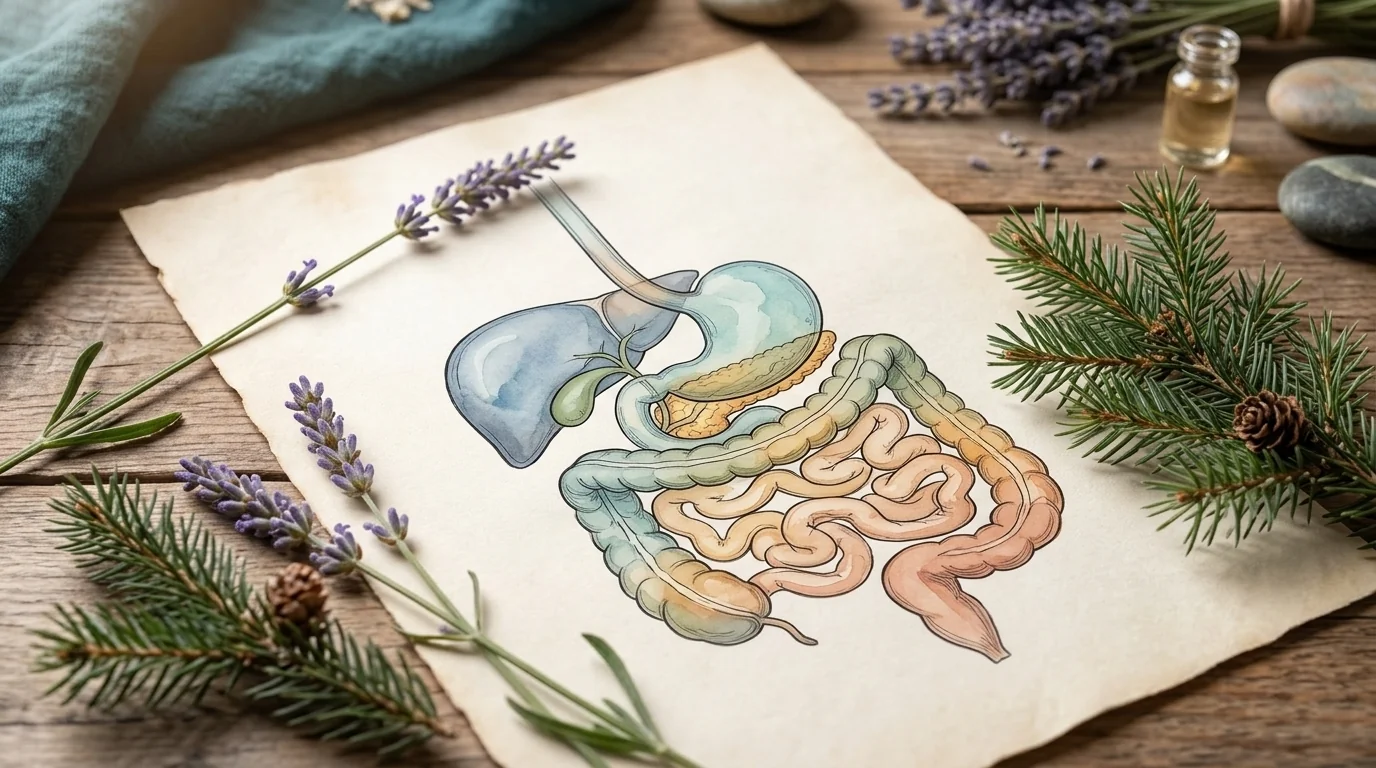
Our gut and our brain are always talking. With a few slow breaths and a calming scent, we can help them both say, "we're okay."
I teach how scent reaches the brain, and how plant chemistry works with brain chemistry, in my free Science of Nature course.
In my next post, I'm opening a brand-new topic: peptides and bioregulators, what they are and where the research really stands. Until then, what if your next deep breath came with a little forest air? 🌲